Q&A with outgoing Tahsildar Chandrajit Rajput: ‘Malegaon is not what it is made to look from outside’

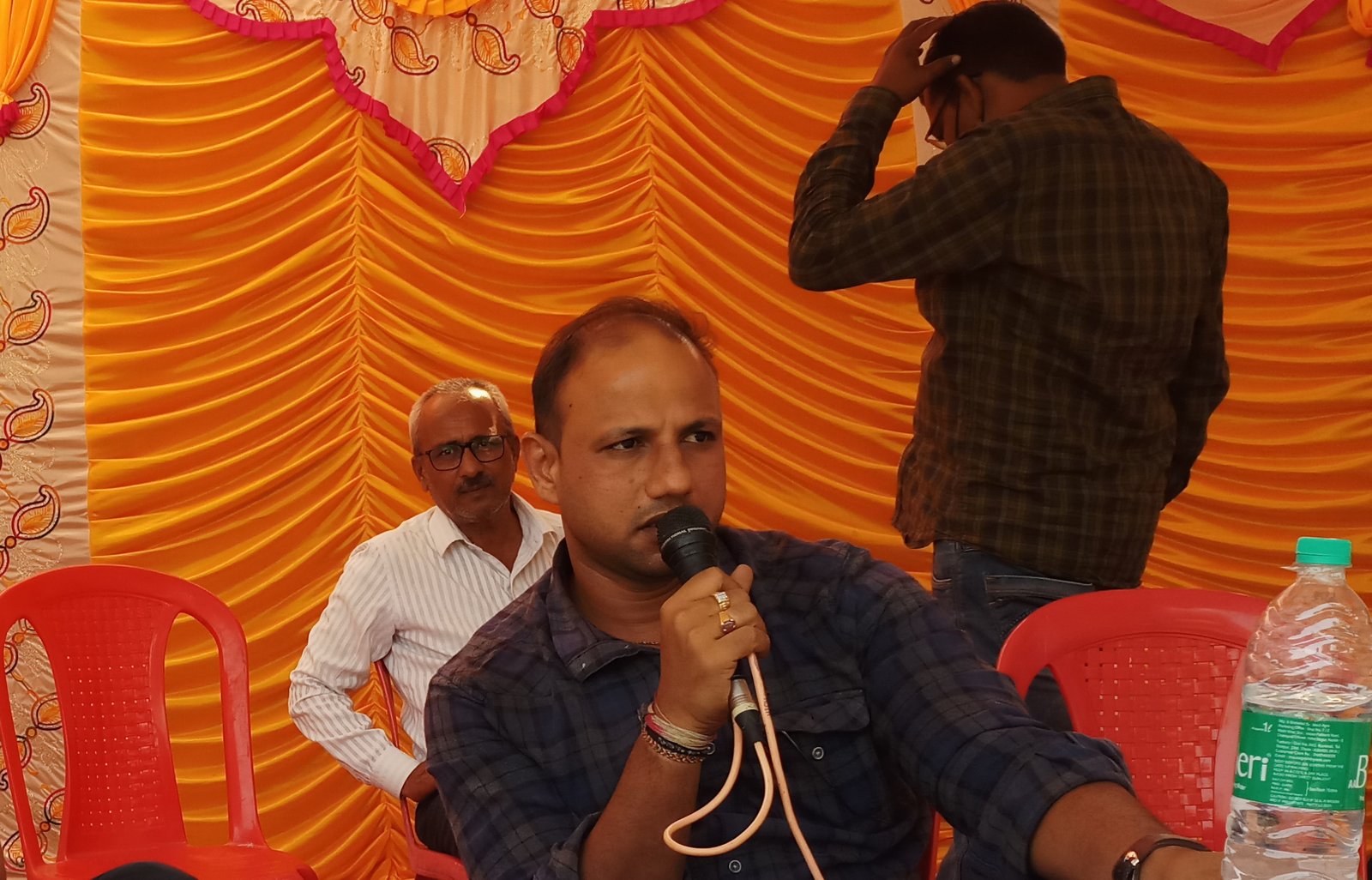
On November 25, 2020, Tahsildar Chandrajit Rajput oversaw voting for a no-confidence motion against Dabhadi sarpanch. (Picture: The Voice of Malegaon)
He had his hands full since day one of him assuming the office in February 2019. In just a few weeks’ time, he had to put in place his team for the 2019 Lok Sabha elections. During his tenure he hardly missed out on a chance to help people. Once he took a Muslim couple injured in a road accident in his car to a hospital in Nashik. This did not end there. He also partly paid the hospital bills for them.
Here is a glimpse into the public life of outgoing Tahsildar Chandrajit Rajput who in a tete-a-tete with Founder and Editor-In-Chief Ashfaque Ismail talks about his “longest stint as Tahsildar Malegaon” and how he has been positively affected by the people in the city of powerlooms. Rajput also gives reasons as to why he would like to come back to the town, perhaps in a different role, if given an opportunity. Excerpts;
Q: For you it seems the journey in the public life has been quiet satisfactory. Do you think it has paid off? Who or what inspired you to be a part of the highly sought-after civil services?
Ans: Let me directly come to the point. In 2004, I wrote the Maharashtra Public Services Commission (MPSC) exams for a Police Sub-Inspector (PSI)’s post. Fortunately, I cleared it and got selected. But I didn’t take up the job. I had a much bigger vision for myself. Then after a few years’ gap, I again gave the MPSC exams.
But this time it was for a Naib (Deputy) Tahsildar’s post. It was in 2007. I cleared the exams and became a Naib Tahsildar. My first posting was in Mahoda village in Yevatmal district. So this is how my journey in the public life began. After that I served at many places in different capacities.
Before coming to Malegaon, I was Tahsildar Dharangaon in Jalgaon district. Yes, in terms of job satisfaction, the public service has fully paid off. It has been quite satisfactory. As Tahsildar Malegaon, I had to oversee 151 villages of which 125 are gram panchayats. A huge task which I think was possible only through a team work with my staff.
Q: Back in February 2019, you took up the responsibility of Tahsildar Malegaon. Did you face any challenges in the beginning? If yes how you were able to tackle those tough times?
Ans: When I came to Malegaon I had this narrow landscape view of the town in my mind. I haven’t had seen the city properly yet. I thought Malegaon started at Daregaon Hills and ended at New Bus Stand on the Old Agra Road.
But sooner I realised that its boundaries transcended much beyond that. In just a few weeks’ time I had to put my team on standby for the Lok Sabha elections. Though I was incharge (Assistant ERO) of the 115-Malegaon Outer Assembly Constituency, I had to make some new arrangements in the 114-Malegaon Central Assembly Constituency.
Q: Fair enough! But in terms of challenges what type of situation you had to face especially in the run up to the 2019 Lok Sabha elections?
And: When I go back in time and think I am forced to believe this was quite challenging work for me. Ahead of 2019 Lok Sabha elections, we were given the task of adding 63 more polling booths in the Malegaon Central Assembly Constituency. At this point of time we came face to face with the real Malegaon.
In the beginning we felt the task was quite daunting. As we had to go through small alleys, we decided to go into these narrow lanes on bike. So for a month or so I rode a bike to go into each and every locality. And then we set up 63 new polling booths based on the demography in those areas.
Q: Could you share with our readers experiences you garnered during your stint as Tahsildar Malegaon? Any particular event or person that has etched in your memory?
Ans: In March 2020, we all had to face the global Covid-19 pandemic. When I say, ‘we’, I mean the general public as well as the government. The government imposed a complete lockdown in the aftermath of Covid-19. Back then people in large number were walking back to their hometowns in the northern parts of the country.
Mostly this outflux of people was from Mumbai that has been the source of livelihood for thousands of migrant workers. As there was a ban on inter-state movement of people we intercepted around 42 migrant workers. These men were going to their home in Chhatarpur and adjoining districts in Madhya Pradesh. We had no other option but to keep them in a quarantine.
Q: How long you kept them in an isolated place?
Ans: As they were migrant workers, we decided to intercept them on the highway only. We kept them at the Jat Samaj Mangal Karyalaya behind hotel Food Village near Chalisgaon Phata. Apart from giving them a roof, we also made arrangement of food and water for them. I also contributed from my own pocket. One Antali Singh from Chhatarpur would time and again ask us to release him. But every time he came we would tell him that it was not possible.
Then one day he came to us with a sad news. He told us that his father was no more. And that he will now go to his home at any cost. At this stage I decided to take a concrete step. And send these migrant workers back to their villages in Chhatarpur and adjoining districts in Madhya Pradesh.
Q: Then how did you take this matter forward? In the pandemic situation it would have been a quite tough decision to take.
Ans: At this point of time I got in touch with the District Magistrate, Chhatarpur. I wrote several emails to him giving details about the migrant workers and their plight. In those letters, I sought an NOC from his office for smooth transfer and assimilation of these migrant workers into their home villages. Fortunately, everything went as per our plan. And just within a few weeks these migrant workers were on a bus to their home with all the necessary government approvals.
Q: What does Malegaon mean to you? Could you tell us one thing which you have liked about the town and one thing which you might have detested?
Ans: Before coming to Malegaon I had imagined a particular picture in my mind about the town. I knew that there is a distinct segregation of people on religious lines. But trust me this segregation is just geographical. This separation is not sentimental in nature. There could be some negative instances but that does not disturb the social fabric as a whole. It can never rather. People live with each other in communal harmony.
People particularly those in the eastern part are more excited about life and work. Luckily, I happen to be the longest serving Tahsildar Malegaon. So I got more time than any other Tahsildar to spend with the people. From personal experience I can tell you that Malegaon is not what it is made to look from outside. It is just a one-sided portrayal done without looking at the other side.
Q: During the lockdown a Christian family from Manmad contacted you. The son wanted to exhume his mother’s body buried on the Church premises. Could you tell us more about the episode? What exactly transpired at that time?
Ans: There was this lady who had died of Covid-19 during the lockdown. She had come to Malegaon for treatment but could not win the fight against corona. She was subsequently buried on the Church premises. Her son was running from pillar to post to get his mother’s body out of the grave. He wanted to take it back to Manmad.
The reason he gave us back then was that it was his mother’s last wish to be buried next to her kith and kin in her ancestral graveyard in Manmad. After he did not get a respite he then came to me. Since he wanted to exhume the body it required certain legal formalities to be fulfilled. I also played my part. I gave him an NOC and based on that the body was exhumed in presence of the police.
The police conducted a spot panchnama and allowed this man to take his mother’s body to Manmad in an ambulance. He was told that he will be taking care of all the Covid-19 guidelines during the 45 minute journey and beyond that. This way he was able to fulfill his mother’s last wish.